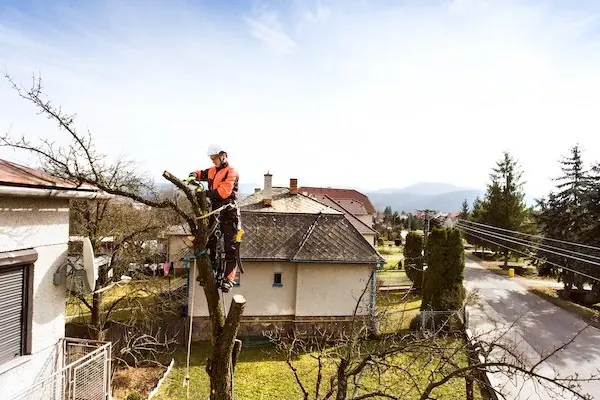
When a tree comes down
Most storm damage along the Scarborough coast comes from winter cold fronts sweeping in from the west and north-west, bringing strong, gusty winds and heavy rain. Saturated sand loses its grip on roots, and big canopies act like sails. Limbs snap, trees split at weak forks, and occasionally a whole tree tips over.
When it happens, there are a few things to do straight away:
- Keep people and pets well clear of the tree and anything it is touching.
- If a power line is involved, treat it as live, stay away and call Western Power. Nothing should be touched until they have made it safe.
- If the house is damaged and there is any risk of collapse or water getting in, the State Emergency Service can help with emergency temporary repairs.
- Take photos if it is safe to do so, for your insurer.
- Then call us on the number above with a description of what has happened.
Making it safe
Storm-damaged trees are some of the most dangerous tree work there is. Wood that has broken or is pinned under its own weight is loaded in unpredictable ways, and cutting the wrong piece first can cause sudden movement. Hung-up limbs, called widow-makers for good reason, can fall at any time.
A contractor will assess what is loaded, what is stable and what is likely to move before starting. Often the first step is to secure the loose material with ropes, then remove pieces in a careful order. Taking weight off a roof or a car is done gradually, so the structure is not damaged further.
Clearing up
Once the immediate hazard is dealt with, the contractor can:
- remove the fallen limbs or tree
- assess and prune the rest of the tree if it is still standing
- chip the branches and carry away the wood
- grind the stump if the tree has been lost
A written description of the damage and the work done is often helpful for insurance claims.
Trees that tend to fail
On the coast, common failures include:
- Tall Norfolk Island pines dropping heavy branches and occasionally uprooting in saturated sand.
- Eucalypts with included bark at a fork, where two stems grow together with bark trapped between them, creating a weak union.
- Peppermints with long, heavy, horizontal limbs.
- Top-heavy hedges and screens of tea tree or pittosporum collapsing.
- Previously topped trees, where weakly attached regrowth breaks out.
Preventing the next one
Storm damage cannot be prevented entirely, but it can be reduced. Before winter, it is worth having large trees near the house checked for:
- dead wood that will come down in the first strong wind
- long, end-heavy limbs that would benefit from shortening
- splits, cracks or included bark at forks
- signs of root problems, such as lifting soil or a new lean
- dense canopies that could be thinned to let the wind through
The pruning page and tree lopping page explain how this kind of preventive work is done. The cost guide explains why emergency and storm work often costs more than planned work.