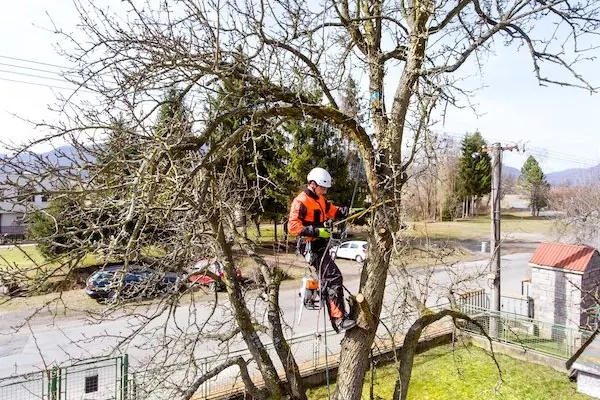
Pruning is maintenance, not rescue
The cheapest tree work is the job done before something goes wrong. A light prune every few years keeps dead wood out of the canopy, stops limbs growing into roofs and keeps the weight of the tree in balance. Compared with an emergency call after a winter front or a heavy lopping job after a decade of neglect, it costs very little.
Pruning also tends to be what coastal trees need. Salt and wind scorch the outer tips, and dead twigs build up on the ocean side. Taking that material out cleans up the look of the tree and removes what would otherwise come down in the next blow.
Types of pruning
Deadwooding removes dead and dying branches. It is the most common pruning on mature trees near the beach and is often all that is needed.
Clearance pruning cuts branches back from roofs, gutters, walls, solar panels, driveways and boundaries. A typical target is to keep branches clear of the roof line so they cannot scrape tiles or drop leaves straight into gutters.
Crown thinning selectively removes branches from inside the canopy to let wind and light through, lowering the load on the tree in storms.
Crown lifting removes lower limbs to raise the canopy above paths, driveways and lawns.
Formative pruning shapes young trees early so they grow into a sound structure, with one leader and well-spaced branches. It is a small job that saves larger ones later.
Hedges and screens in the salt zone
Hedges along Scarborough and Trigg front fences take the full force of the sea breeze. Popular choices include coastal rosemary, lilly pilly, pittosporum, murraya, and tea tree. Each behaves differently:
- Coastal rosemary tolerates salt well and handles a regular trim.
- Lilly pilly grows fast and needs frequent shaping, and the windward face can burn.
- Murraya gives a dense, glossy screen but can get woody and bare at the base if only the top is trimmed.
- Pittosporum and tea tree make tall screens that can become top-heavy, sprawl, or collapse.
The right cut depends on the plant. Most hedges stay denser if they are trimmed slightly narrower at the top than at the base, so light reaches the lower foliage. Hedges that have been allowed to grow very tall may need to be brought down in stages over a couple of seasons rather than in one hard cut.
What makes a good cut
A good pruning cut is made just outside the branch collar, the slightly swollen ring where a branch joins a larger limb or the trunk. Cutting flush removes the collar and creates a larger wound; leaving a long stub leaves dead wood that rots. Large branches are removed in stages so their weight does not tear bark down the trunk.
Wound paints and sealants are rarely recommended now. Trees seal wounds by growing callus over a clean cut, and sealants can trap moisture. Ask the contractor if you are curious about their approach.
Timing
Most pruning can be done at any time of year, although very hot spells are best avoided for heavy work. Many owners book before winter so that dead and heavy wood is cleared before the stronger fronts. Some flowering trees and fruit trees have preferred windows, and the contractor can advise.
Combining jobs
If you have several trees and hedges, it usually makes sense to have them all done in one visit. The set-up, chipper and travel are shared across the work, and you can ask for each item to be listed separately on the quote so you can decide what to include. See the cost guide for planning ranges, or the tree lopping page if your tree needs more than a tidy-up.